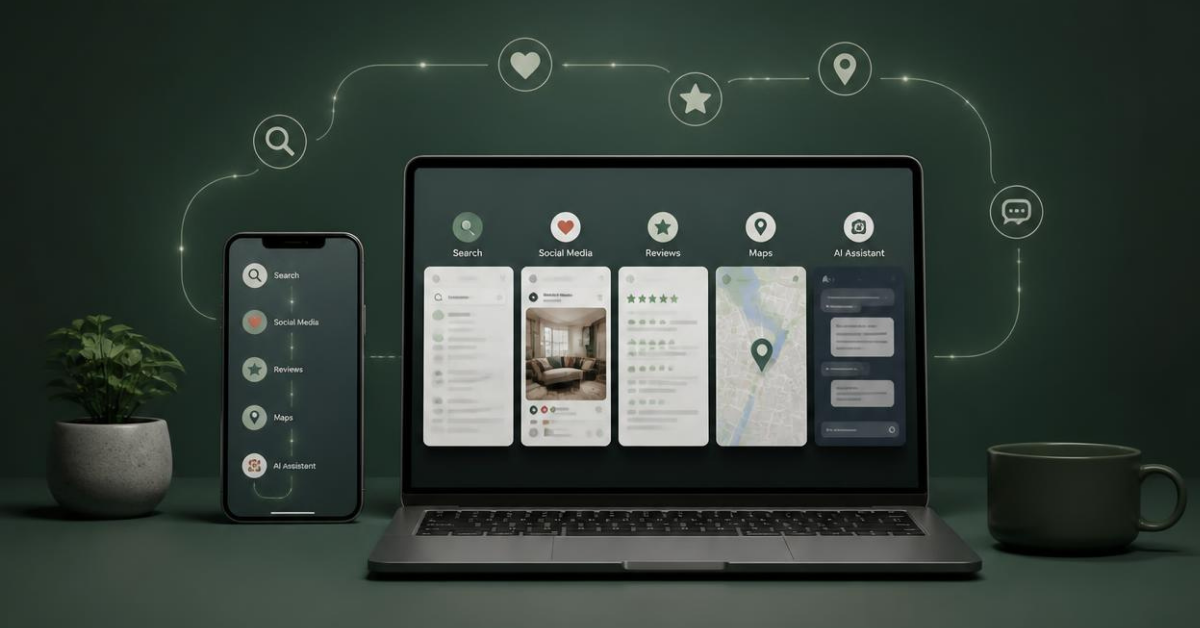
A potential customer looking for a business no longer has to begin with a simple Google search.
They might discover an HVAC company while watching a video, research a security provider on LinkedIn, compare local businesses through Google, read reviews, visit several websites, and use an AI-powered search experience to understand their options.
As a result, the path is becoming less predictable.
At the same time, Google itself is changing. AI Overviews and AI Mode increasingly allow people to ask longer, more detailed questions, continue with follow-up questions, and explore information without following the traditional pattern of entering a keyword and clicking one of ten blue links. Google reported in June 2026 that AI Overviews had more than 2.5 billion monthly active users and AI Mode had passed one billion.
For service businesses, the practical issue is not whether Google, social media, or AI will become the single dominant discovery channel.
Instead, it is whether your business can be found, understood, and trusted as customers move between them.
Quick Answer
Customers in 2026 can discover businesses through traditional Google results, Google Maps and local listings, social platforms, paid advertising, referrals, websites, online reviews, and increasingly AI-powered search experiences.
These channels often work together rather than independently. For example, a customer might first discover a company through social content, search its name on Google, read reviews, visit its website, and return later to make contact.
Therefore, visibility increasingly means creating a consistent and credible presence across the places customers use to research and evaluate their options.
Key Takeaways
- Google remains an important discovery channel, but Google Search itself is becoming more conversational and AI-assisted.
- Social platforms can contribute to discovery, research, credibility, and familiarity before someone visits a website.
- AI-powered search can answer more complex questions and surface supporting sources, websites, brands, and other information.
- Different industries have different discovery journeys. Someone needing urgent HVAC service behaves differently from a company researching a commercial security provider.
- Businesses should measure qualified inquiries and customer journeys, not simply website traffic or social reach.
- Visibility only creates an opportunity. Response, follow-up, and the experience after an inquiry still influence what happens next.
What Has Changed About Customer Discovery in 2026?
The biggest change is not that one platform has replaced another.
Instead, customers have more ways to research.
Traditional search was relatively straightforward. Someone entered a phrase such as “HVAC company near me,” reviewed the results, and visited one or more websites.
That behaviour still exists.
However, search interfaces are expanding beyond short keyword queries. Google says people using AI Mode are asking questions differently, including questions that are more complex and conversational. In May 2026, Google reported that AI Mode queries had more than doubled every quarter since its launch.
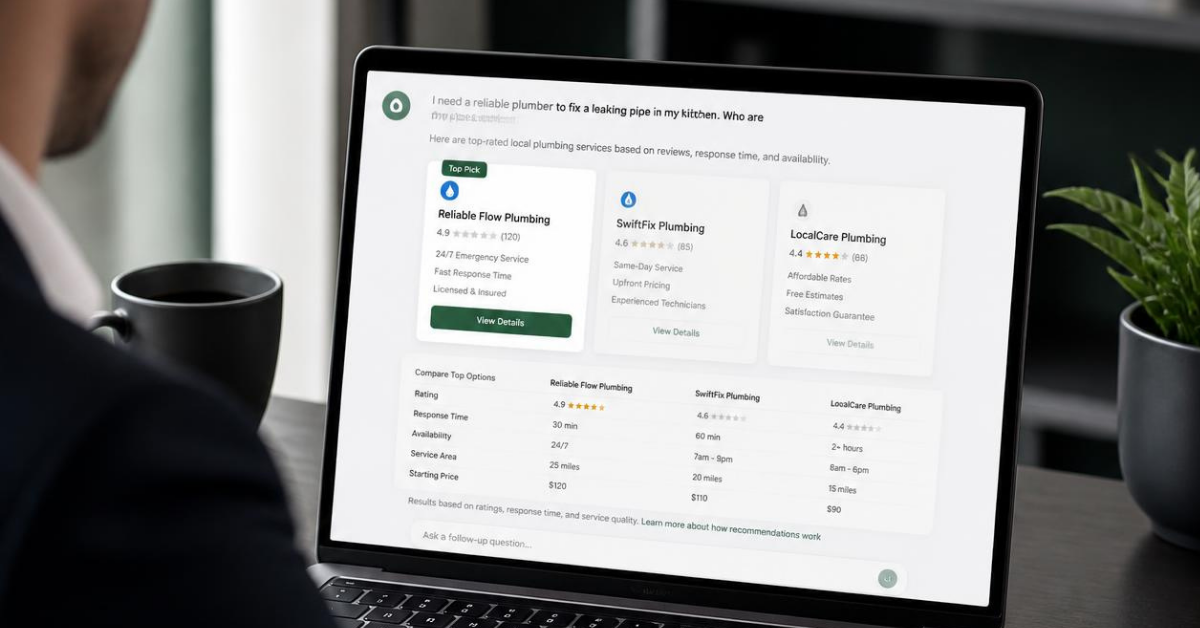
Google has also connected AI Overviews more directly with AI Mode. As a result, users can move from an initial AI-generated answer into follow-up questions while keeping the context of the search.
That changes what “searching” can look like.
Instead of:
commercial security company Toronto
someone could ask a much more specific question about what to consider when selecting a security integrator for multiple commercial properties.
Similarly, instead of:
furnace repair
a homeowner might research why a furnace is behaving a certain way, what type of professional handles the issue, and what questions to ask before booking service.
Therefore, the business discovery process can begin before the customer searches for a company by name.
Google Is Still Important, but Google Is Changing
It would be a mistake to interpret the growth of AI search as evidence that conventional search visibility no longer matters.
Google continues to connect AI-generated experiences with websites and sources from across the web. In 2026, it also introduced additional links and website previews within its generative AI search experiences to help people explore original content and relevant sources.
In addition, Google has emphasized original and useful content as it develops AI Search.
For businesses, that creates several layers of Google visibility.
A potential customer may encounter:
- Traditional organic search results
- Local and map results
- Paid search advertising
- AI Overviews
- AI Mode
- Business information and reviews
- Images and video
- Links and sources surfaced within AI-generated responses
These experiences do not necessarily replace one another. Instead, they can become different entry points into the same customer journey.
For an HVAC or home service company, local relevance, service information, reviews, and an accurate Google Business Profile can remain important.
Meanwhile, for a commercial security company, useful technical and industry content may help buyers researching a more complicated project.
For a professional service firm, educational content can help answer questions before a prospective client feels ready to speak with someone.
Ultimately, the right approach depends on how customers actually research that particular service.
Social Media Is Also a Discovery Environment
Businesses sometimes treat social media only as a publishing channel.
Post something. Get impressions. Count likes.
However, that misses part of its role.
Social platforms can introduce a company to someone who was not actively searching for it. They can also provide additional context after someone already knows the company’s name.
For example, a prospective customer might encounter a short educational video, a LinkedIn post from a company leader, a project photo, customer feedback, or an explanation of a common problem.
They may not contact the company immediately. Instead, they might search the business later.
This makes social content particularly interesting for services where familiarity and credibility matter before an inquiry.
For a commercial security integrator, for example, LinkedIn can provide an opportunity to demonstrate knowledge of access control, system integration, commercial facilities, and project considerations to professional audiences.
For HVAC and home service businesses, visual and educational content can help explain common homeowner questions and demonstrate the people and expertise behind the company.
Therefore, the role of social should be judged against the customer journey, not simply the number of likes on an individual post.
AI Search Adds Another Layer to Discovery
AI-assisted discovery deserves attention, but businesses should avoid treating it as a completely separate marketing universe.
Google’s AI Mode illustrates why.
Google says AI Mode can break complex questions into related subtopics and perform multiple searches to develop an answer. Its responses can also include links that allow users to explore the web further.
Therefore, content still matters.
Clear explanations, original expertise, accurate business information, relevant pages, and useful answers give search systems more information to understand what a company knows and what its website is about.
However, this does not mean publishing an article guarantees an AI citation or recommendation. AI-generated answers can vary, and visibility depends on numerous factors outside a business’s control.
A more useful objective is to make the business easier to understand across both human and machine-assisted discovery.
For example, if someone, or an AI system helping that person, is trying to determine:
What should I consider when choosing a commercial security integrator?
a detailed article addressing that question provides more useful context than a page that simply says:
We provide industry-leading security solutions.
In other words, specific information travels better than generic claims.
Discovery Looks Different Across Service Industries
One of the biggest mistakes businesses can make is copying another company’s marketing strategy without considering how their own customers buy.
Customer discovery differs substantially across industries.
HVAC and Home Service Businesses
An HVAC customer may have immediate intent.
The furnace stops working. The house is uncomfortable. As a result, the customer wants to know who serves the area, whether the company appears credible, and how quickly someone can help.
Google Search, Maps, reviews, paid search, local visibility, and clear service pages can therefore matter greatly.
However, the same customer may behave differently when considering a planned furnace replacement.
They might spend days researching options, reading articles, watching videos, comparing businesses, and checking reviews.
The same company can therefore face both urgent discovery and research-led discovery.
Its marketing should account for both.
Commercial Security Companies
Commercial security can involve a longer and more complicated buying process.
A prospective customer may discover a security integrator through Google, LinkedIn, a referral, an industry relationship, or previous familiarity with the company.
From there, they may research the company’s website, projects, expertise, people, certifications, and services before starting a conversation.
In addition, several decision-makers may eventually become involved.
For these companies, being visible matters, but being credible after discovery matters just as much.
Licensed Insolvency Trustees
The discovery journey can be different again for trustees.
Someone experiencing financial difficulty may initially search for information about debt, creditor pressure, consumer proposals, bankruptcy, or available options rather than immediately searching for a specific trustee.
As a result, they may research privately for some time before making contact.
That gives clear educational content an important role.
Amber 90 has previously explored this journey in its article about how debt clients move from Google Search toward a trustee consultation.
The broader lesson is that the first search may be about a problem, not a provider.
Therefore, businesses that only optimize around their company name and primary service can miss that earlier stage of discovery.
Customers May Encounter Your Business More Than Once
Marketing attribution often encourages businesses to ask:
Which channel generated this lead?
That question is useful, but it can oversimplify what actually happened.
Consider a hypothetical commercial security buyer.
First, a facility manager sees a useful LinkedIn post from a security integrator.
Several weeks later, the company begins evaluating an access control project.
The manager then searches Google, recognizes the company’s name, visits its website, reads an article, and leaves.
Later, another member of the team returns directly to the website and submits an inquiry.
Which channel deserves credit?
LinkedIn introduced the company.
Google helped the buyer rediscover it.
Meanwhile, the website supported evaluation.
Finally, direct traffic recorded the eventual conversion.
Treating only the final website visit as important would hide much of the journey.
For this reason, businesses should be cautious about making marketing decisions based entirely on last-click attribution.
Visibility and Credibility Need to Work Together
Being discovered is useful only if the next interaction gives someone a reason to continue.
Imagine a homeowner finds an HVAC company through Google.
The listing looks credible, so they visit the website.
However, the website loads poorly on mobile, service areas are unclear, and there is no obvious way to request help.
The business technically succeeded at discovery, but the customer experience still failed.
The same problem can happen with AI and social discovery.
For example, a strong LinkedIn post can create interest, but the website still needs to support the claims being made.
Similarly, an AI-powered search experience might surface information from a company’s content, but inaccurate or outdated service pages can create confusion when someone investigates further.
Discovery channels should therefore be viewed as entrances into a larger system.
At Amber 90, we often look at that system as:
Visibility → Discovery → Inquiry → Lead Response → Follow-Up → Sales Opportunity → Business Outcome
A weakness anywhere along that path can affect the value created by the stages before it.
What Should Businesses Consider Doing in 2026?
The response to fragmented discovery should not be opening accounts on every platform.
After all, businesses have limited time and budgets.
A more practical starting point is understanding where customers are likely to look and what information they need at each stage.
Strengthen the Information Customers Find About You
Review whether your website clearly explains:
- What you do
- Who you serve
- Where you operate
- What problems you solve
- How your process works
- Why your experience is relevant
- How someone can take the next step
Generic service descriptions give customers, search engines, and AI systems less useful context.
Answer Questions Customers Ask Before Contacting You
Look at conversations happening in sales calls, consultations, quote requests, customer emails, and support interactions.
Those questions can reveal valuable content opportunities.
For example, if commercial security prospects repeatedly ask whether existing equipment can work with a proposed system, that could become useful educational content.
Likewise, if HVAC customers repeatedly ask when repair stops making sense and replacement should be considered, that question deserves a clear explanation.
Real customer questions can be more valuable than producing content simply because a keyword tool shows search volume.
Keep Local Information Accurate
For location-dependent businesses, ensure important information about locations, service areas, hours, contact details, and services is consistent and current.
In particular, Google Business Profile should be treated as an active business asset rather than something configured once and forgotten.
Build Expertise Where Your Audience Actually Spends Time
A B2B security firm may have a stronger reason to invest in LinkedIn than a residential plumbing company.
By contrast, a home service business may benefit more from local search, reviews, useful video content, and visual social platforms.
Therefore, channel selection should follow customer behaviour.
Make the Next Step Easy
Every discovery channel eventually needs somewhere to lead.
That may be a phone call, estimate request, consultation, booking form, direct message, or another appropriate action.
Most importantly, the next step should be clear and appropriate to the customer’s level of intent.
What Should Businesses Measure?
More discovery channels create more data, but not necessarily more clarity.
Therefore, businesses should avoid measuring every channel by the same standard.
For search, useful indicators may include search impressions, clicks, relevant rankings, calls, forms, and qualified inquiries.
For social media, reach and engagement can provide context. However, businesses should also consider profile visits, website activity, direct inquiries, assisted conversions, and whether content is reaching the intended audience.
For lead generation overall, measures such as qualified inquiries, booked appointments, lead response time, follow-up rates, sales opportunities, and customer acquisition cost can provide stronger business context.
Google also introduced additional Search Console tools in 2026 aimed at helping site owners understand visibility associated with generative AI Search experiences.
Ultimately, measurement should help answer a more useful question than “How many people saw us?”
It should help determine whether the right people are finding the business and what happens after they do.
Common Mistakes Businesses Should Avoid
Assuming AI Search Means SEO Is Finished
One mistake is assuming AI search means SEO is finished.
However, Google’s AI experiences continue to use and link to information from the web. Search optimization still helps businesses make their information accessible, understandable, and relevant.
Trying to Be Everywhere at Once
Another mistake is trying to be everywhere at once.
A business does not automatically need TikTok, LinkedIn, Instagram, Facebook, YouTube, Google Ads, SEO, and an aggressive AI-search strategy simultaneously.
Instead, the right mix depends on customers, market, resources, competition, and business goals.
Measuring Channels Only by Immediate Leads
A third mistake is measuring channels only by immediate leads.
Some interactions introduce the company or build familiarity before another channel receives the eventual conversion.
Therefore, immediate lead generation should not always be the only measure of whether a channel contributes value.
Ignoring Lead Response
Finally, businesses should avoid focusing entirely on discovery while ignoring response.
Generating additional inquiries does little to solve a process where suitable leads routinely receive slow or inconsistent follow-up.
How Amber 90 Can Help
The changing discovery journey creates a strategic question for businesses:
Where are the right customers finding us, and what happens next?
Amber 90 helps service businesses examine that journey across digital strategy, SEO, websites, paid advertising, social content, lead generation, CRM, and follow-up systems.
However, that does not mean every business needs every channel.
The objective is to identify the channels that matter to the audience, make the business easier to find and understand there, and ensure that suitable opportunities are handled effectively after an inquiry arrives.
Businesses particularly interested in changes happening within local Google Search can also read Amber 90’s coverage of Google’s online-estimate shift for service businesses. Meanwhile, B2B businesses exploring the connection between professional content and AI discovery can review Amber 90’s article on optimizing LinkedIn content for AI chatbots.
If you are unsure where potential customers are discovering your business or where opportunities may be dropping off afterward, Amber 90 can help review your current marketing and identify areas worth improving.
Frequently Asked Questions
How Are Customers Finding Businesses in 2026?
Customers can find businesses through Google Search, local results, Maps, social media, paid advertising, referrals, online reviews, websites, video content, and AI-assisted search experiences. The exact mix depends on the industry, customer, location, and type of purchase.
Is Google Still Important for Finding Local Businesses?
Yes. Google remains an important discovery environment, particularly for services with local or immediate intent.
However, the Google experience itself is expanding through AI Overviews, AI Mode, conversational follow-ups, local features, and other search formats.
Are People Using AI to Search for Businesses?
AI-assisted search is increasingly part of how people explore information, compare options, and ask complex questions.
For example, Google’s own AI Mode has exceeded one billion monthly active users globally, demonstrating significant adoption of conversational search within Google itself.
Does AI Search Mean Businesses Should Stop Investing in SEO?
No. AI search still depends heavily on information available across the web, and Google’s AI search experiences continue to provide links to supporting websites and original sources.
Therefore, businesses should continue focusing on useful content, technical accessibility, relevance, and a strong website experience rather than treating AI visibility as a replacement for SEO.
Should Every Service Business Use Social Media for Customer Discovery?
Not necessarily. The value of a social platform depends on the audience, service, buying journey, available resources, and type of content the business can produce consistently.
Instead of trying to use every platform, businesses should prioritize channels where their customers and relevant decision-makers are likely to spend time.
Can Social Media Influence a Sale Even If It Does Not Generate the Final Lead?
Yes. A social interaction can introduce a business or reinforce familiarity before someone later searches Google, visits the website, receives a referral, or makes direct contact.
This is one reason last-click attribution can provide an incomplete picture of customer discovery.
How Can a Business Improve Its Visibility in AI Search?
There is no guaranteed method for being cited or recommended by an AI system.
However, businesses can improve the quality of the information available about them by maintaining technically accessible websites, publishing accurate and genuinely useful content, clearly explaining their expertise and services, and keeping important business information current.
Which Discovery Channel Should a Service Business Prioritize?
Start with customer intent rather than platform popularity.
For example, an emergency home service business may place greater emphasis on local and high-intent search. Meanwhile, a B2B security company with a longer sales cycle may benefit from combining search visibility with professional content and relationship-building channels such as LinkedIn.
Conclusion
Customer discovery in 2026 is becoming less linear.
A person can begin with Google, encounter a company on social media, research it through its website, consult reviews, use an AI-assisted search experience to compare options, and return days or weeks later through another channel.
However, businesses do not need to chase every new platform.
Instead, they need to understand where their customers actually look, provide useful and consistent information in those places, and make the transition from discovery to inquiry as straightforward as possible.
Google, social media, AI search, websites, reviews, referrals, and advertising can all contribute different pieces of the journey.
Therefore, the more useful question is no longer simply “Where did this lead come from?”
It is “How did this customer find, evaluate, and ultimately choose us?”
That distinction can lead to much better marketing decisions.
If your business is unsure how search, social, AI discovery, and lead follow-up fit together, contact Amber 90 to discuss your current approach.
Sources Referenced
Primary sources used for current AI-search developments include Google’s May 2026 Search announcement, which details the expansion of AI Mode, conversational follow-up, and new Search capabilities; Google’s June 2026 guidance for website owners, which provides current AI Overviews and AI Mode adoption figures; and Google’s May 2026 updates describing how AI Search surfaces links and original web content.
Google’s reporting on how people use AI Mode was also referenced for current information about conversational and more complex search behaviour. Amber 90’s current Insights library was reviewed to distinguish this article from its existing coverage of local estimates, social trends, trustee discovery, LinkedIn, and AI-related topics.