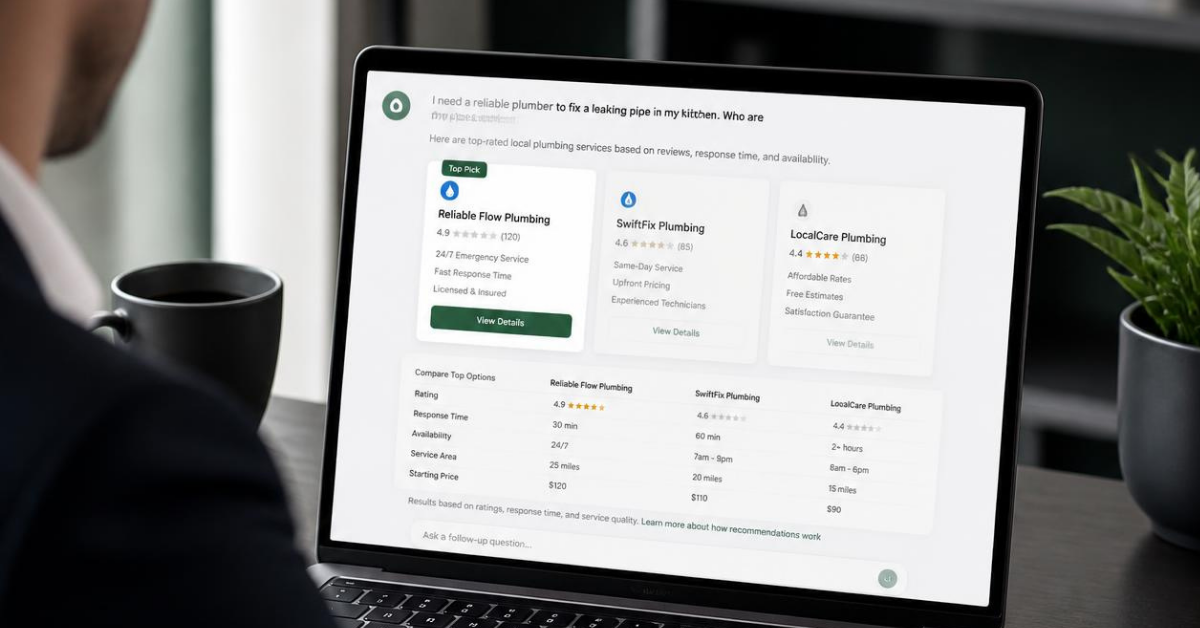
Google Search is changing what happens between a customer asking a question and visiting a business website.
Instead of always relying on a list of traditional search results, Google can now show AI-generated summaries that answer part of a search directly. These AI Overviews can bring together information from different sources and include links for people who want to explore further.
For HVAC and home service companies, security businesses, Licensed Insolvency Trustees, and other service-based businesses, this raises an important question.
What happens when a potential customer gets useful information from Google before they ever reach your website?
It does not mean traditional search engine optimization is finished. Google says established SEO practices remain relevant to AI Overviews and AI Mode. However, what is changing is how businesses should think about visibility, website traffic, useful content, and the journey from a search to an actual inquiry.
Quick Answer
Google AI Overviews are AI-generated summaries that can appear within Google Search for certain queries. They allow users to understand a topic without necessarily visiting every website that contributed information.
For service businesses, this means strong Google rankings still matter, but rankings and traffic should not be viewed in isolation. Businesses also need accurate, useful content that clearly explains what they do, demonstrates relevant expertise, and gives potential customers a reason to take the next step.
However, the impact will not be equal across every search. Informational questions may be answered more fully inside Google, while searches involving a local provider, consultation, estimate, or urgent service still require the customer to do something next.
Therefore, for service businesses, understanding that difference is more useful than treating every decline in clicks as a decline in demand.
Key Takeaways
- Google AI Overviews can answer some questions directly within search results.
- Research suggests people are less likely to click external results when an AI summary appears.
- Informational searches and service-intent searches should not be treated the same way.
- Google says traditional SEO practices remain relevant to its generative AI search features.
- Unique, useful content based on genuine expertise is becoming more important than generic articles that repeat widely available information.
- Service businesses should measure qualified inquiries, calls, consultations, and other meaningful actions alongside traffic and rankings.
What Are Google AI Overviews?
Google AI Overviews are AI-generated responses that appear for some searches.
They are designed to help users understand a topic or question more quickly while providing links to relevant sources for further exploration. Google says AI Overviews and AI Mode rely on its existing Search systems and index to find relevant information.
However, they do not appear for every query.
The type of search matters.
For example, research from Pew Research Center found that longer searches, full questions, and complete sentences were more likely to trigger an AI summary than short queries. In its analysis of U.S. browsing behaviour from March 2025, 53% of searches containing 10 words or more produced an AI summary, compared with 8% of one or two-word searches.
That distinction is particularly important for service businesses because people use Google for very different reasons.
Someone searching:
“Why is my furnace blowing cold air?”
is looking for information.
On the other hand, someone searching:
“Furnace repair near me”
has a very different goal.
Therefore, that difference in search intent should influence how businesses interpret changes in traffic.
Are Google AI Overviews Reducing Website Clicks?
There is evidence that AI-generated search summaries can reduce some external clicks.
Pew Research Center analyzed 68,879 Google searches performed by 900 U.S. adults in March 2025. When an AI summary appeared, users clicked a traditional search result in 8% of visits. When there was no AI summary, they clicked a traditional result in 15% of visits.
In addition, links included directly inside AI summaries were clicked in only 1% of visits where an AI summary appeared. Pew also found that users ended their browsing session after 26% of searches containing an AI summary, compared with 16% of searches that displayed traditional results without an AI summary.
Those findings matter, but businesses should be careful about how they interpret them.
For example, the study examined U.S. browsing behaviour. It does not establish that every Canadian industry, local market, or type of search will experience the same change.
More importantly, it does not mean every lost website visit represents a lost customer.
How Could Google AI Overviews Affect Service Businesses?
For service businesses, fewer informational visits do not automatically mean fewer business opportunities.
For example, someone who previously visited an HVAC company’s website simply to learn why a furnace was making a noise may now get a basic explanation directly from Google. That website visit may disappear from analytics without representing a lost service call.
Therefore, the more useful question is whether searches with genuine service intent are still generating:
- Calls
- Estimate requests
- Consultation requests
- Form submissions
- Booked appointments
- Qualified inquiries
This distinction becomes increasingly important as search evolves.
A customer journey may now look something like this:
- A person asks Google an informational question.
- An AI Overview provides an initial explanation.
- The person continues researching.
- They search for companies or professionals that can help.
- They compare websites, reviews, expertise, and service information.
- They contact one or more providers.
The website has not disappeared from the process.
Instead, it may simply enter the journey at a different stage.
At Amber 90, we look at search as one part of a wider customer journey.
Visibility → Discovery → Inquiry → Lead Response → Follow-Up → Sales Opportunity → Business Outcome
A business can appear prominently in search and still lose an opportunity later because its website is unclear, its contact process creates friction, or inquiries are not handled consistently.
Therefore, while AI Overviews may change the discovery stage, what happens after discovery still matters.
What Do AI Overviews Mean for HVAC and Home Service Businesses?
HVAC, plumbing, mechanical, and other home service businesses often receive both informational and high-intent searches.
Informational searches might include:
- Why does my air conditioner keep running?
- How long does a furnace normally last?
- Why is my water heater making noise?
- What causes low water pressure?
- When should an HVAC system be serviced?
Google may be able to answer part of these questions directly.
However, service-intent searches are different.
Examples include:
- HVAC contractor near me
- Emergency furnace repair
- Air conditioner repair in Toronto
- Plumbing company near me
- Furnace replacement estimate
These searches usually require more than an explanation. The person needs a provider.
As a result, local SEO, clear service pages, accurate business information, reviews, service-area details, and a well-maintained Google Business Profile continue to matter.
The goal should not be to create dozens of pages for slightly different versions of every possible question.
Instead, use informational content to demonstrate expertise and service pages to help customers make decisions.
Search Intent Should Shape the Page
An educational article and a service page should not try to do exactly the same job.
For example, an article about why an air conditioner is not cooling should help the reader understand possible causes and when professional help may be appropriate.
Meanwhile, a service page for air conditioning repair should clearly explain:
- What services are available
- Where the company operates
- What types of problems it handles
- How someone can request service
- What customers can reasonably expect next
That separation creates a clearer experience for both searchers and businesses.
What Do AI Overviews Mean for Security Companies?
Commercial security customers can have longer and more complicated research journeys.
A potential customer may research:
- Access control systems
- Video surveillance
- Alarm monitoring
- Security system integration
- Building access technologies
- Commercial security upgrades
An AI-generated summary may answer some introductory questions before the person visits a security company’s website.
As a result, detailed expertise becomes more important.
Instead of publishing only general pages that say a company installs security systems, useful content could explain:
- How different access control approaches work
- Questions businesses should consider before replacing an existing system
- How commercial security needs vary by property type
- What businesses should consider when integrating multiple security technologies
- How an upgrade process may differ from a new installation
Commercial security also often involves more than one decision-maker.
For example, a facility manager researching access control may need different information than an owner, IT lead, property manager, or procurement contact evaluating the same project.
Therefore, content that recognizes those different concerns can be more useful than a generic overview written for everyone.
What Do AI Overviews Mean for Licensed Insolvency Trustees?
The customer journey can look different again for Licensed Insolvency Trustees.
Someone researching debt solutions may spend significant time looking for information before contacting anyone.
For example, they may search questions about:
- Consumer proposals
- Bankruptcy
- Debt repayment options
- What a consultation involves
- Who is legally authorized to provide certain insolvency services
If Google provides more introductory information directly within Search, a trustee website still has an important role.
In particular, the website can help establish credibility, explain regulated processes accurately, answer sensitive questions in plain language, and show potential clients what they can expect if they choose to make contact.
For trustees, accuracy carries additional weight.
Therefore, educational content should clearly distinguish regulated insolvency services from broader debt-help terminology and should be reviewed when rules, guidance, or commonly searched questions change.
Publishing more content is not automatically better if that content is vague or creates confusion.
Why Generic Service Content Has Less Room to Hide
AI search increases the pressure on content that says the same thing as every competitor.
For example, if several HVAC companies publish nearly identical articles explaining what a furnace is, or several agencies publish the same general explanation of local SEO, there is little reason for a search system or customer to prefer one version.
Google’s 2026 guidance for generative AI search places particular emphasis on creating valuable, unique, non-commodity content. Google specifically recommends adding a distinct point of view, first-hand experience, and information that goes beyond simply summarizing material already available elsewhere.
For a service business, useful information gain could include:
- Questions customers regularly ask
- Practical considerations based on real service experience
- Regional considerations
- Original photos or videos
- Clear explanations of the service process
- Common misunderstandings
- Situations where one option may or may not be appropriate
- Insights from technicians, specialists, or other people performing the work
Ultimately, the objective is not to make content longer.
It is to make it more useful.
Does SEO Still Matter With Google AI Overviews?
Yes.
Google says the same core SEO principles that support traditional Search remain relevant to AI Overviews and AI Mode because its generative AI features are grounded in its existing Search ranking and quality systems.
In addition, Google says websites do not need a separate technical trick or special optimization to become eligible for these features. Existing SEO fundamentals still apply.
Making Important Pages Easy to Understand
Your site should clearly explain your services, locations, expertise, and how customers can contact you.
Creating Useful, Original Information
Answer real customer questions and add something beyond what is already available on dozens of competing websites.
Maintaining Accurate Business Information
Service areas, contact information, business details, and key service information should stay current.
Keeping the Website Technically Accessible
Google still needs to crawl, index, and understand your pages.
Using Helpful Images and Video
Google’s current guidance also encourages high-quality visual content when it genuinely improves the page. In addition, images and videos can create additional opportunities for visibility in generative search experiences.
SEO is not being replaced.
Instead, the standard for useful content is becoming harder to satisfy with generic material.
Do Businesses Need AEO as Well as SEO?
AEO, or Answer Engine Optimization, is often used to describe efforts to make information easier for AI-powered systems to understand and surface.
For Google Search specifically, however, businesses should be careful about treating AEO as a completely separate technical discipline.
Google’s current guidance says foundational SEO remains the basis for generative AI visibility and specifically advises website owners to focus on meaningful SEO rather than chasing special AEO or GEO shortcuts.
For businesses, the practical approach is straightforward.
Create pages that:
- Answer important questions directly
- Use clear headings
- Include specific expertise
- Are technically accessible
- Provide original value
- Make the next customer action clear
These practices help people first while also making the information easier for search systems to understand.
How Should Service Businesses Respond to Google AI Overviews?
There is no guaranteed formula for appearing in an AI Overview.
Therefore, instead of searching for shortcuts, businesses should review whether their website genuinely helps potential customers.
Start With Real Customer Questions
Sales calls, consultations, service requests, and emails can reveal useful content opportunities.
At Amber 90, we often see that some of the strongest content ideas already exist inside a business. They appear in the questions customers ask before they buy, book, or request more information.
As a result, those questions can often reveal gaps in the website.
Add Experience Instead of Repeating Definitions
A generic article explaining what an HVAC system is offers limited value.
Instead, an article explaining common warning signs, when to call a technician, what information to have ready, and what to expect when service is booked is more useful.
Review Service Pages Separately From Blog Content
Blog articles can educate.
Service pages, on the other hand, need to help customers decide whether the company is relevant to their needs.
Both matter, but they serve different purposes.
Make the Next Step Obvious
Someone reaching your site after using an AI-generated answer may already understand the basics.
Therefore, make it clear whether the next step is to:
- Call
- Request an estimate
- Book a consultation
- Submit a form
- Speak with a specialist
Use AI Tools Carefully
Google says generative AI can be useful for research and organizing original content, but creating large numbers of low-value pages may violate its spam policies if the material adds little value for users.
Therefore, human expertise and review still matter.
A Practical HVAC Example
Consider an HVAC company that receives organic traffic from an article answering:
“Why is my furnace blowing cold air?”
An AI Overview may now answer several common causes directly within Google.
The business could respond by creating ten new articles targeting slightly different versions of the same question.
However, that would probably miss the point.
A stronger approach would be to improve the existing article.
For example, it could explain:
- Basic checks a homeowner can make
- Warning signs that may require professional attention
- Information a technician may ask for
- What typically happens when service is booked
- Related problems that could produce similar symptoms
As a result, the page now provides something more useful than a short summary.
A Practical Security Example
A commercial security company may see a different customer journey.
Someone researching access control may initially use Google to understand the technology. An AI Overview may answer basic questions before that person ever reaches a provider’s website.
Later, however, the same prospect may search for integrators, compare project experience, review specific capabilities, and involve other decision-makers.
In that situation, losing one early informational visit may matter less than whether the company remains visible and credible when the search becomes commercial.
Therefore, raw traffic should not be the only measure of search performance.
How Can Businesses Measure the Impact of AI Search?
Search performance should increasingly be viewed through several signals.
Organic Impressions
Are your pages still appearing in Google Search?
Generative AI Visibility
Google is rolling out a dedicated Generative AI performance report in Search Console to a subset of website owners.
The report includes impression data from AI Overviews and AI Mode and can show which pages receive visibility, along with information by country, device, and date. However, Google notes that the report is not yet available to every property.
Search Clicks and Click-Through Rate
Are people still choosing to visit your website when they see it?
Qualified Inquiries
Are the people contacting your business actually relevant to the services you provide?
Calls and Bookings
For local service businesses, these can be more meaningful than page views alone.
Conversion Rate
Of the people who arrive through organic search, how many complete an action that matters to the business?
Lead Quality
A large amount of informational traffic may look impressive while producing few real opportunities.
By comparison, a smaller number of visitors with clear service intent can be much more meaningful.
At Amber 90, we often see businesses evaluate SEO primarily through rankings and traffic. Those measures still matter, but they become less useful when separated from inquiries, calls, consultations, and opportunities.
AI search makes that distinction even more important.
Important Terms to Understand
Search Intent
Search intent is the purpose behind a search, such as learning about a problem, comparing providers, or finding a company ready to perform a service.
Local SEO
Local SEO is the process of improving a business’s visibility for geographically relevant searches, including searches tied to a city, service area, or nearby provider.
Qualified Inquiry
A qualified inquiry comes from someone whose needs, location, timing, or other requirements reasonably match the services a business provides.
What Should Businesses Avoid Assuming About AI Overviews?
“SEO Is Dead”
Google’s own guidance says the opposite. Core SEO practices remain relevant to its generative AI search features.
“We Need Hundreds of New AI Pages”
Google specifically recommends valuable, non-commodity content and warns against creating large amounts of content primarily to manipulate rankings or AI-generated responses.
“Every Lost Click Is a Lost Customer”
Some lost visits may come from people who only wanted a basic answer.
Therefore, measure inquiries and customer actions before drawing conclusions.
“We Need Special AI Schema to Appear”
Google says there are no additional technical requirements or special optimizations necessary specifically for AI Overviews or AI Mode.
“Being Cited by AI Automatically Generates Leads”
Visibility is useful, but it is only one part of the customer journey.
Ultimately, the website, offer, reputation, contact process, response, and follow-up still influence what happens next.
How Amber 90 Can Help
Search is becoming less about measuring success through a single ranking or traffic number and more about understanding how people discover, evaluate, and contact businesses.
Amber 90 works with service-based businesses on SEO, website strategy, content, lead generation, and the processes that connect online visibility with incoming opportunities.
That can include reviewing:
- What potential customers are searching for
- Which pages currently receive organic visibility
- Where content gaps exist
- Whether service pages clearly support customer decisions
- How inquiries are captured
- What happens after someone makes contact
Businesses interested in the relationship between traffic and actual business opportunities can also read Amber 90’s related article on lead volume versus lead conversion.
For local service businesses, Amber 90’s article on Google’s Online Estimates shift provides additional context on how Google is changing the path between local discovery and customer action.
If you’re unsure how AI-driven search could affect your current visibility, Amber 90 can help review your search presence, website content, and customer journey to identify practical areas worth improving.
Frequently Asked Questions
What is a Google AI Overview?
A Google AI Overview is an AI-generated summary that can appear within Google Search for certain queries. It helps users understand a topic quickly and can include links to relevant websites for further exploration.
Do Google AI Overviews reduce website traffic?
They can reduce clicks for some types of searches. Pew Research Center found that U.S. users were less likely to click traditional search results when an AI summary appeared. However, the effect on an individual business will depend on its industry, search terms, customer intent, and market.
Does SEO still matter with Google AI Overviews?
Yes. Google says its generative AI features remain based on its core Search ranking and quality systems, so foundational SEO practices continue to matter.
Do businesses need a separate AEO strategy?
Not necessarily for Google Search. Clear answers and well-structured content can be useful, but Google says businesses do not need special AI-specific optimization to become eligible for AI Overviews or AI Mode. Strong SEO and genuinely useful content remain the foundation.
Can AI Overviews affect local service searches?
Yes, but the effect depends on search intent. Informational questions may be answered more extensively inside Google, while searches for a nearby contractor, consultation, estimate, or urgent service usually require additional action from the customer.
Should businesses publish more content to appear in AI Overviews?
Not simply for volume. Instead, Google recommends unique and useful content rather than large numbers of generic pages covering similar questions.
What type of content is most useful for AI search?
There is no guaranteed format. Google’s current guidance favours useful, reliable, original content that adds value beyond information already widely available. For service businesses, practical expertise and clear customer-focused explanations can help create that additional value.
How do I know whether AI search is hurting my leads?
Compare organic impressions and clicks with qualified inquiries, calls, consultations, bookings, and other meaningful customer actions. A decline in informational traffic does not necessarily mean the same decline has occurred in customer demand.
Can businesses measure visibility in AI Overviews?
Google is rolling out a Generative AI performance report in Search Console. For properties with access, it includes impression data from AI Overviews and AI Mode. However, access is currently limited to a subset of website owners.
Does my business need special structured data for AI Overviews?
No special AI Overview structured data is required. Google says normal SEO eligibility and technical best practices continue to apply.
Conclusion
Google AI Overviews are changing how people move from a question to a website, particularly for informational searches.
However, that does not mean service businesses should abandon SEO or start rebuilding their content around every new AI trend.
Instead, the more practical response is to understand which searches matter to the business, create information that adds genuine expertise, and measure whether search visibility is contributing to meaningful customer actions.
For HVAC companies, security businesses, trustees, and other service providers, the biggest change may be how SEO performance is evaluated.
Traffic will continue to matter, but it should not stand alone.
As Google answers more questions directly, qualified inquiries, calls, consultations, bookings, and other customer actions become increasingly important measures of whether search visibility is contributing to the business.
If you’re unsure how your current website and search strategy are positioned for AI-driven search, get in touch with Amber 90 to review where your business is visible, what customers find when they search, and where there may be opportunities to improve the path from discovery to inquiry.
Sources Referenced
- Google Search Central, AI Features and Your Website. Google explains how AI Overviews and AI Mode relate to existing Search systems and confirms that no additional AI-specific technical requirements are necessary.
- Google Search Central, Optimizing Your Website for Generative AI Features on Google Search. Google’s 2026 guidance covers SEO fundamentals, non-commodity content, generative AI visibility, and common AEO/GEO misconceptions.
- Google Search Central, A New Resource for Optimizing for Generative AI in Google Search, May 2026.
- Google Search Central, Guidance on Generative AI Content. Guidance on AI-assisted content and scaled content abuse.
- Google Search Console Help, Generative AI Performance Report. Details on Google’s AI Overview and AI Mode impression reporting and its current limited rollout.
- Pew Research Center, Google Users Are Less Likely to Click on Links When an AI Summary Appears in the Results, July 2025.
- Amber 90, Insights, including related coverage of Google search changes and lead conversion.